The metals are already dissolved. Somebody just has to pick them up.
Minoreal owns and is developing TERRAEUS: a magnetic bead, coated in plant polyphenols, that binds rare earth elements, cobalt, nickel and base metals straight out of acid mine drainage and industrial process water — then releases them on command.
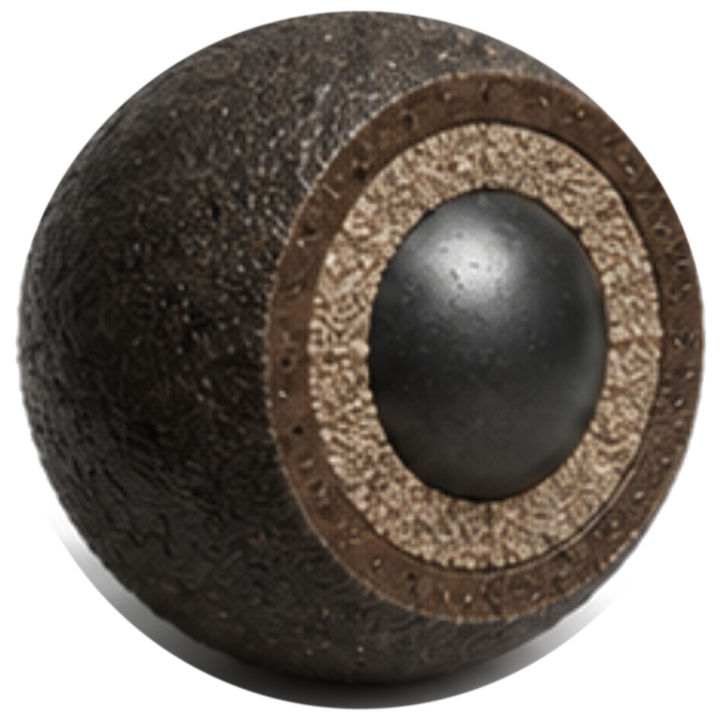
Mine water is a metals deposit that nobody mines.
Across the US coal and hardrock mining regions, thousands of discharge points release water carrying iron, aluminum and manganese — and, in measurable concentration, the same rare earths and specialty metals the country imports. The water is acidic, the metals are dissolved, and the chemistry is consistent enough from site to site to design against.
Treating that water is not optional. Many closed and legacy sites carry obligations with no end date, funded as a permanent cost line that produces a sludge and a bill. The metals go into the sludge, and the sludge goes into a landfill.
Which is the opportunity in one sentence: the collection already happens, the pumping is already paid for, and the resource is already in solution. What is missing is a recovery step cheap enough to bolt onto a plant nobody wanted to build in the first place.
Three materials, three jobs.
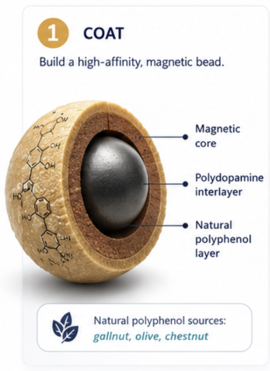
The bead is built in layers and each layer earns its place. A magnetic core, so loaded beads can be pulled out of a moving stream with a field rather than a filter. A polydopamine interlayer, which anchors the chemistry to the core and keeps it there through repeated cycles. And an outer shell of natural polyphenols, whose catechol and galloyl groups are what actually grip the dissolved metal ions.
The polyphenols come from agricultural residues — gallnut, olive, chestnut, grape pomace. That matters for cost, and it matters for the supply chain story, but mostly it matters because these molecules hold multivalent metal ions well in acidic water, which is exactly the condition mine drainage presents.
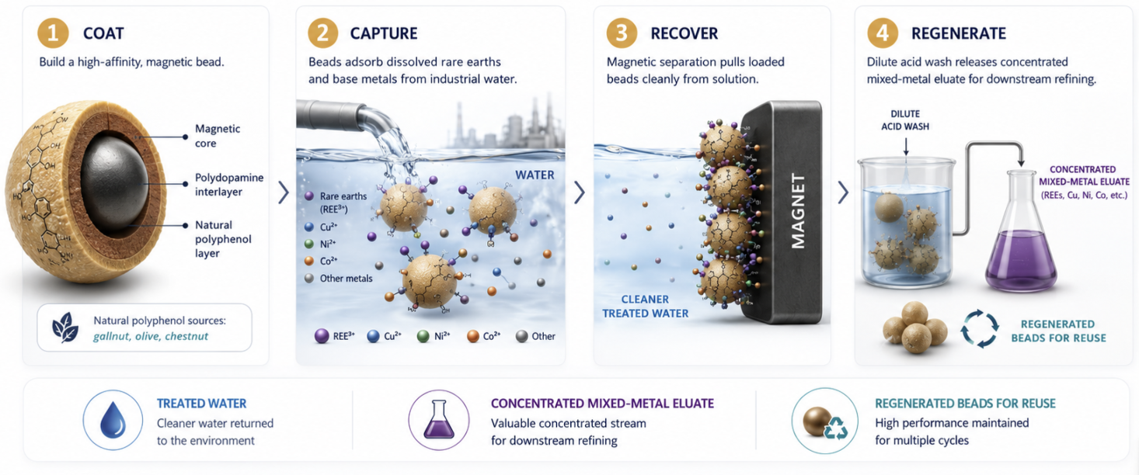
Coat, capture, recover, regenerate.
The cycle is deliberately unexciting, which is the point. Every step uses equipment a water treatment operator already understands.
Build a high-affinity magnetic bead
Polyphenol extract is deposited over a polydopamine-primed magnetic core. The result is a particle with a dense population of metal-binding sites on its surface and a ferromagnetic center that never touches the water chemistry. See Figure 1 for the layer structure.
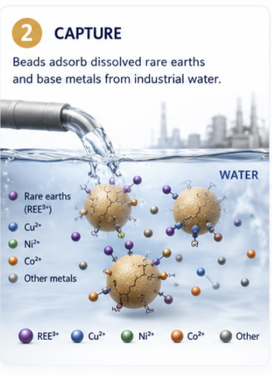
Beads adsorb dissolved metals from the raw stream
Introduced into the influent, the catechol and galloyl groups on the shell chelate rare earth ions (REE3+) along with Cu2+, Ni2+, Co2+ and other dissolved metals. No heating, no pressure, no added flocculant chemistry.
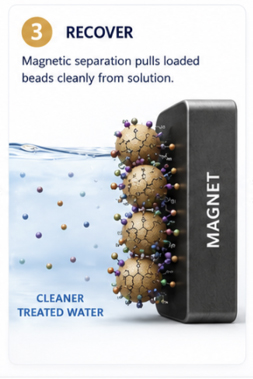
A magnet pulls the loaded beads out cleanly
This is the step that makes the rest practical. Magnetic separation lifts loaded beads out of solution in seconds and leaves cleaner treated water behind. Nothing blinds, nothing fouls, nothing has to be dredged.
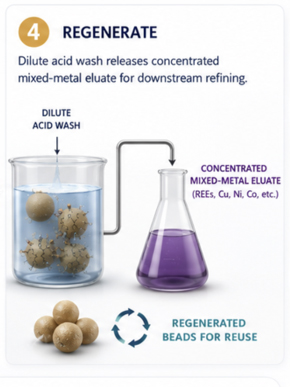
Dilute acid strips the metals; the beads go back in
A dilute acid wash releases the captured metals as a concentrated mixed-metal eluate — REEs, Cu, Ni, Co — ready for conventional downstream separation and refining. Stripped beads return to the stream. How many cycles they survive, and at what performance, is what sets operating cost. It is the central question of our bench program.
The acidity does the sorting.
A mixed-metal eluate is only valuable if it is not an indiscriminate soup. TERRAEUS is designed to sit inside a pH-stepped treatment train — the kind already used to bring mine drainage back toward neutral — and to use those steps as separation stages. Binding affinity varies with pH, so different metals report to different points in the train.
The design intent is that the rare earths concentrate in one band and cobalt, nickel and copper in another. Selectivity is a primary objective of the bench program, not a demonstrated result.
Figure 2 Intended integration into a pH-stepped acid mine drainage treatment train.
What comes out of the water.
Twelve elements, two very different reasons to care about them.
Appalachia first, because the water is already there.
Our commercial target is the Appalachian acid mine drainage corridor: a multi-state footprint of discharge points where the precipitated solids are among the more rare-earth-enriched mine waters characterized in the United States, and where treatment is already a funded, permanent activity.
It is also where the policy and the geology point the same way — active Department of Energy fossil-energy programs on rare earths from coal byproducts, Defense Production Act priorities on domestic critical minerals, and a regional economy with a direct interest in the answer.
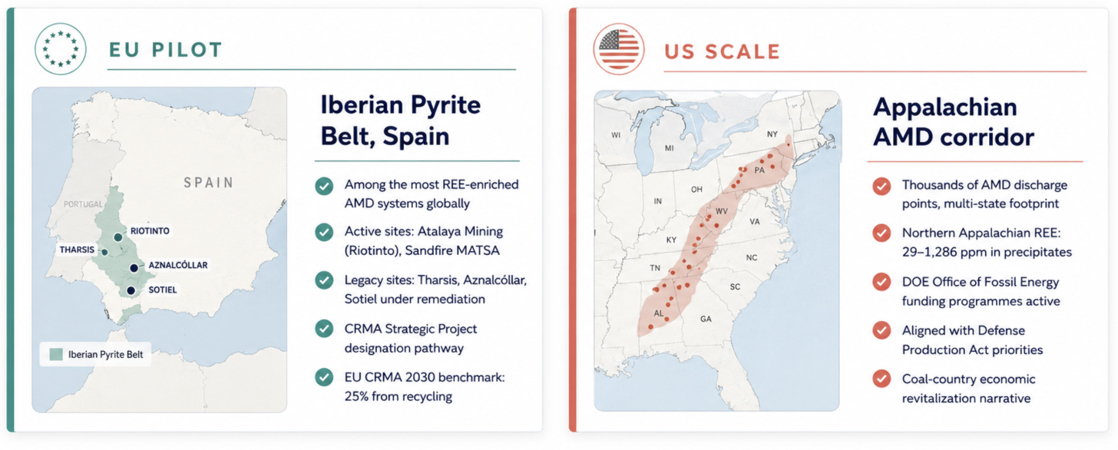
Figure 3 The Appalachian AMD corridor. Discharge points span a multi-state footprint from Alabama through Pennsylvania.
Coal-region drainage
Active and legacy discharges across the corridor. The first commercial target.
Hardrock mine water
Pit water and seepage carrying copper, zinc, cobalt and nickel alongside the contaminants that have to come out anyway.
Tailings seepage
Storage facilities under long-term monitoring, where recovery can offset containment cost rather than add to it.
Industrial process water
Metal finishing, plating, semiconductor and battery-materials effluent, where discharge limits are tight and the dissolved load has value at the meter.
Paid to treat the water. Keeping what comes out.
The treatment obligation already exists and is already funded. That is what makes the service fee the foundation of the model rather than an afterthought: it does not depend on a metal price, and it does not require anyone to start doing something they were not already doing.
Treatment service
Contracted fees from operators and responsible parties who carry a water treatment obligation. Predictable, regulation-driven, independent of commodity cycles.
Base metal concentrate
Copper, zinc, nickel and cobalt sold into established markets. The margin layer above the service fee.
Critical materials
Rare earths, gallium and scandium delivered into domestic separation and refining. Small tonnage, disproportionate strategic weight.
Technology licensing
For operators who would rather run the process themselves across a portfolio of sites, once the platform is field-proven.
Where the program actually is.
We would rather be believed later than impressive now, so this is stated plainly.
Bench validation
Capture, elution, selectivity and bead durability measured across representative water chemistries.
Priority filings
Patent applications in Minoreal's own name covering sorbent composition, preparation and the recovery process.
Field pilot
A continuous side-stream cartridge on a live discharge, with a host site partner. Site selection is open.
Commercial deployment
Multi-site rollout with contracted treatment and offtake for the recovered material.
Minoreal Inc.
A Nevada corporation. Minoreal owns the TERRAEUS platform outright — there is no upstream licensor and no royalty ahead of it — and is developing it for deployment in the United States.
Fady Khatib — President
[PLACEHOLDER — replace with 2–3 sentences: sector background, prior operating or technical roles, and what he is responsible for at Minoreal.]
- Entity
- Minoreal Inc.
- Jurisdiction
- Nevada, United States
- Platform
- TERRAEUS™ sorbent recovery
- Ownership
- Wholly owned by Minoreal
- Stage
- Bench development
Get in touch.
We are looking for host sites for a field pilot, downstream separation and refining partners, and technical collaborators.
[PLACEHOLDER — registered office address, Nevada]
[PLACEHOLDER — telephone]